
The Texas Music Pioneers Exhibit of the Texas Music Museum features over sixty Texas musicians in fourteen musical genres. Learn about several of the earliest Texas musicians to contribute to the development of each of the following categories of music: Blues, Classical, Conjunto, Country, Cowboy/Cowgirl, Gospel, Jazz, Orquesta, Pop, Ragtime, Rock, Soul, Tejano Vocalists, and Western Swing.
Displays include information about each musical genre, artists’ biographical information, artist memorabilia, antique recording cylinders and 78 rpm records, antique phonographs, radios and sheet music from Texas’ two earliest publishers, and QR codes that connect to online recordings which enable visitors to enjoy these musicians’ unique sounds.

Lydia Mendoza, Collectión de Oro.

Flaco Jimenez with his father and son.
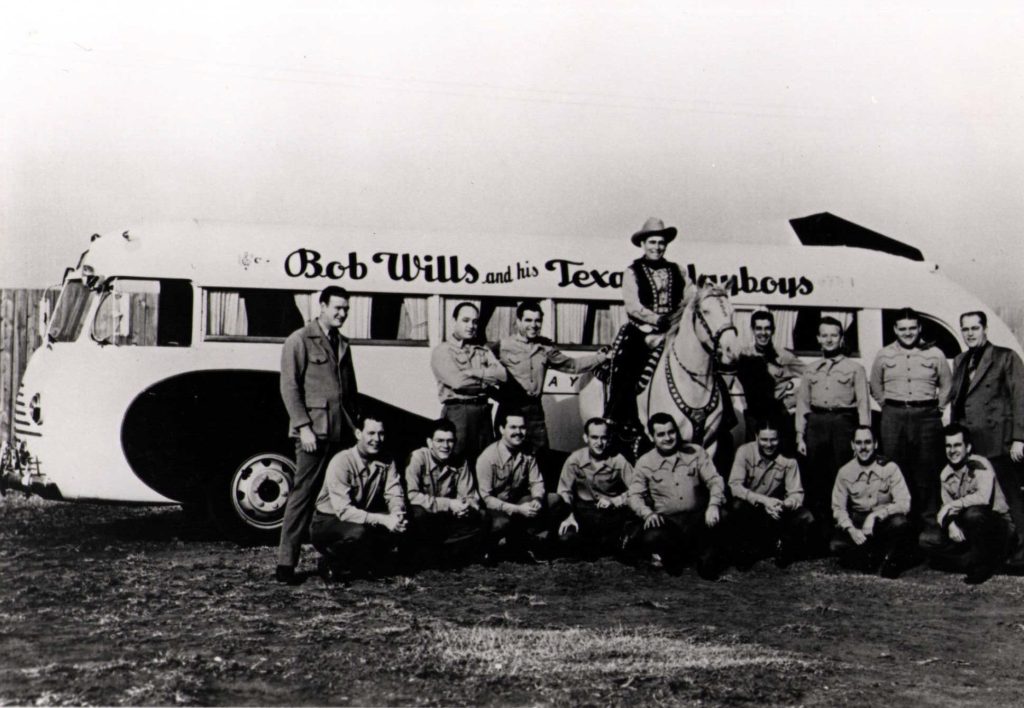
Bob Wills and the Texas Playboys.
Dates
Currently on view.
Location
Texas Music Museum.
Price
Admission is free,
donations are welcome.
Musician bios
Mary Carson

Mary Carson was born in Houston, Texas in the 1880’s and made her first public performance as a singer when she was six years old.
A lyric soprano, the beautiful birdlike quality of her voice delighted audiences throughout the world. After a vigorous course of study under some of Italy’s greatest maestros, she made her professional debut there in Verdi’s “La Sonnambula,” in the role of Amina. Her extensive repertoire included twenty-five operas in Italian, French, and German, and innumerable English songs.
One of her greatest achievements was singing “The Barber of Seville” twice in one day and again on the following night — a feat which the average opera singer would hardly attempt. Her voice recorded perfectly, and she became one of the favorites among Edison disc artists before World War I.
Her first Edison record, O Dry Those Tears, was the most familiar and best liked of all her popular songs. Critics praised her interpretation and technical mastery, finding no break between the registers of her voice.
However, the praise she prized most was from a little English boy, who heard one of her records and then told his mother that her singing was sometimes “like a lark in the sky” and sometimes “like a thrush on the ground.”
After her performing career, she taught music in Houston, until her death there in 1951.
Eva Garza

Eva Garza, one of seven children, was born May 11, 1917 in San Antonio, Texas to Procopio V. Garza and Cenobia B.Ramirez. From the age of seven she sang at parties and at the man Institute.While in her school years at Lanier High School, her music teacher heard her sing an opera and was so amazed that she took her to a radio station for an audition.
Eva and a boy sang “Indian Love Call” and “Sweet Mystery of Life” over the radio. In a contest at the Texas Theatre given by the Monte Carlo Brewery in 1935, Eva sang “I’m In the
Mood for Love” and won second place winning $500. Eva entered a contest at the Zaragosa Theatre winning a piano.
In 1935 an official with the radio station KABC, Mr. Lozano, heard Eva sing and asked her to sing on a Spanish hour of music which gave her professional career a boost. In 1935 she was sponsored by Jose Davila of Davila Glass Works to sing on a radio program. In 1936 she began singing at the Nacional Theater with the vaudeville troupe, Netty y Jesús and Don Sauve.
Her big break came in 1937 when she auditioned for Sally Rand (the fan dancer) who was starring at the Majestic Theater. Eva went to audition for Sally Rand and was hired for her “strong voice” and she traveled with Sally Rand to Florida and to Toronto Canada. As Sally Rand’s tour ended after 6 months, Eva returned home. In 1938 she formed her own troupe, “Eva Garza and Her Troupe”, and was the first Tejana from San Antonio to become internationally famous.
She was the first Latina to sing at the Million Dollar Theater in California and over CBS Radio in New York. While on tour she met the famous Mexican Singer, Felipe Bojalil Gil (nicknamed “El Charro”), who sang with a trio called El Charro Gil y sus Caporales.
On Dec. 30, 1939, Eva and Felipe Gil were wed in San Antonio and were married for eleven years, having three children, one of whom became known as the singer Fabricio. Eva continued to sing on the radio, in movies and at theaters in Mexico City.
She sang for the U.S. troops over short wave radio in Spanish, English and Portuguese and was called the “Sweetheart of the Americas”. From Jan 1939 to 1942 she toured in South and Central America and the Antilles.
In 1949 she went to live in Mexico City as she was contracted by radio station XEW (the first radio station in Mexico City) and Churrubusco Studios to perform for three programs a week. She met many famous people from around the world like Augustine Lara, Javier Solis, and Lola Beltran and teamed up with famous stars such as Pedro Infante, Pedro Vargas, Jorje Negrete, Ernesto Alonzo, and Joaquin Paradave.
In 1953 she appeared in several movies such as “Paco el Elegante” and “Mujeres sin Manana”.
Also in the forties, she performed at nightclubs in New York, Cuba, and in Bogota, Columbia where she had a street named after her. During the course of her career she received three Maria Grever Awards as Best Singer of the Year. In 1965 she married artist, Abel Reynosa, who was from Argentina. They lived in Argentina for two years. Columbia Records asked her to return to Mexico to record an album titled “Vuelve Eva Garza Mexican Encores”, and was asked to re-record “Celosa”,”Cantando”, and “Arrepentido” to Arizona, New Mexico, and Los Angeles.
There after, she went on tour While in Tucson, She was diagnosed with double pneumonia. She died there on November 1, 1966 at the age of 49.
Flaco Jimenez (Leonardo Jimenez)
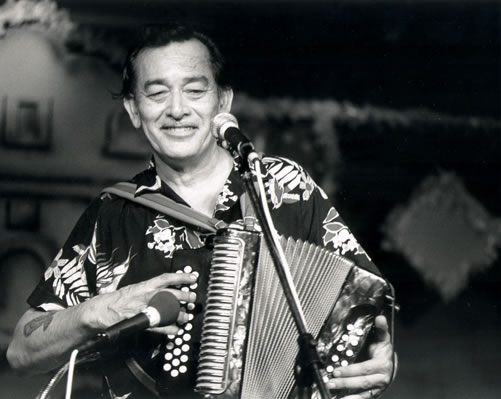
Flaco Jimenez has done more than anyone to spread the sound of conjunto accordion music beyond the Southwest to the rest of the world. Son of the great conjunto pioneer Santiago Jimenez, Sr., Flaco was born in San Antonio on March 11, 1939. All of his brothers and sisters played music around the house, and Flaco carried his father’s accordion when Santiago went to play. After learning to play from his father, Flaco played his first job, a birthday party, when he was twelve years old, earning three dollars.
Flaco soon began to develop his own style of playing, which was faster and flashier than that of his father. By the mid-fifties, Flaco had formed his first Conjunto and soon his recording of the polka “Hasta la Vista,” was his first hit. He and Toby Torres played regularly around San Antonio at places like the East Side Club for many years. Flaco has had many popular records including “Mujer Fatal,” “Victimas de Huracán Beulah,” and “Un Mojado Sin Licensia.” Flaco earned the title “El Rey de Texas” and was a fixture on the Conjunto circuit when in 1972 he recorded with San Antonio native Doug Sahm on Atlantic Records. This was his first crossover into the Anglo musical community. Flaco was featured in the film Chulas Fronteras with his father and brother, Santiago, Jr., and was discovered by Ry Cooder who included Flaco on two of his albums. Flaco also recorded with Peter Rowan and has toured Europe with Cooder. He won a Grammy Award for his album Ay te Dejo San Antonio in 1986 for Best Mexican-American Performer. Another Grammy in the same category followed in 1995 for his album on the Arista label, Flaco Jimenez. But in between, groups that he helped to form also pulled in many honors.
Jimenez was a crucial member of two super groups, the Texas Tornados and Los Super Seven, which received their own Grammys.
Isidoro Lopez

Isidoro was born on April 4, 1939, in Bastrop, Texas, and moved to Austin with his family when he was seven years old. He attended Govalle Elementary, Allan Jr. High, and Austin High School. After graduating from high school in 1957, he joined the Marine Corps.
In 1963, he began working at HEB and then in 1964-1965 as a clerk at the Post Office, and from 1966, he was a mail carrier. During that time, he bought a drum set and soon began playing with Ruben Perez and Johnny Degollado.
From 1968 to 1974, he had his own conjunto until he shifted to a Country Western band, “The Tempos of Country Music” which he continued until 1979.
In 1979, he devoted himself to developing “Fiesta Talent Agency” while working for the Post Office and raising seven children. From 1980 to 1992, he began a career in radio and TV as a part-time announcer in KRET (92.1) in Hutto, Texas.
In 1993, Isidoro became a consultant for the then-proposed COOP Radio and later began a two-hour program of Tejano Music when the station went on the air in 1994. He extended his talent to TV with Tejano Music on the Austin Music Network that same year. By 2005, his show “Fiesta Musical” was shifted to Public Access Community Television.
In addition to promoting Tejano music groups, TV, and radio programs, he is a charter member of ALMA, Austin Latino Music Association, and a board member of the Mexican American Culture Center.
Narcisco Martinez
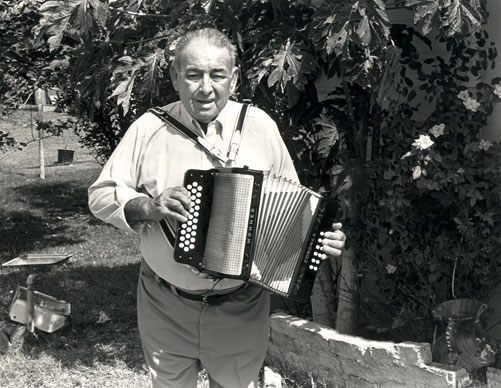
Narcisco Martinez was born on October 29, 1911, in Reynosa , Tamaulipas, Mexico, and was brought to McAllen, Texas by his parents that same year. He lived in Texas since that time, but had never become a naturalized American citizen. A distinctive affiliation to his Mexican heritage forms part of Martinez’ conception of his identity, although for all practical purposes, he considered himself a “Mexico-Americano.” Like many other Conjunto musicians before and after him, Martinez was raised in a rural community and received almost no schooling. Beginning in 1925, he played the accordian at dances and celebrations all over Texas, recording prolifically for Bluebird Records in San Antonio, Texas, between the years 1935 and 1940. The majority of these recordings were Martinez’ own compositions, which covered musical genres such as polkas, redowas, schottisches, waltzes, huapangos and mazurkas.
The most popular of Martinez’ compositions were his polkas, which became the hallmark of the unfolding conjunto style of music in Texas. He was given the title”El Huracan del Valle” by a record promoter, and this name has become synonymous with accordian music in Texas today. Narciso Martinez made little money but earned many followers. He remained popular in the 1940’s and was well known even in the 1950’s, as one of the first Conjunto musicians to begin touring beyond the state of Texas. His music has been absorbed into the ever-expanding tradition of Texas music, and he has been called “The Father of Conjunto Music”. Narciso died on June 5, 1992.
Lydia Mendoza
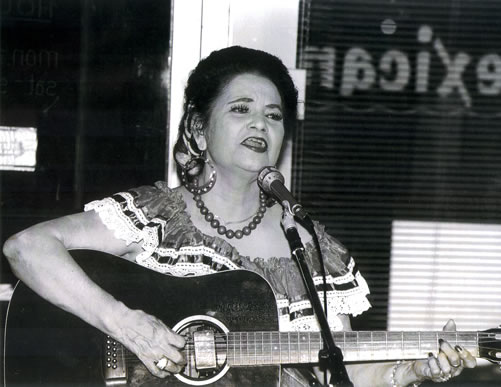
Lydia Mendoza was born in Houston, Texas, in 1916. The Mendoza family traveled and performed professionally throughout the Rio Grande Valley as”Cuarteto Carta Blanca” during the early twenties and thirties. In 1932 the Mendozas settled in San Antonio, Texas, performing on weekends and in the evening in the Plaza Del Zacate, or public market. Lydia played the 12-string guitar, and sang a wide repertoire, which included everything from Spanish art songs to regional corridos and popular songs. In 1934, she began her career as a solo recording artist, cutting just under 200 sides for Bluebird Records between 1934 and 1940. She entered a period of semi retirement in San Antonio in the forties, but her career began its second phase in the fifties, with tours of the United States and Mexico, and recordings on the Falcón, Ideal, Victor and Columbia Labels. In 1977 she appeared as a performer and panelist at the Library of Congress conference on ethnic recordings in America. Today she retains the distinction of being the first woman to make a name for herself in Texas-Mexican border music, “La Alondra de la Frontera” (“The Lark of the Border”).
Her real audience was the Mexican-American working people and she continued to actively perform until her death at the age of 91 on December 20th, 2007.She will always remain a historical figure in the world of Mexican-American popular entertainment.
Bob Wills

Born March 6, 1905 in Hall County, Texas, Bob Wills was known as the “King Of Western Swing” during his lifetime, and still holds that position today. Attend any western swing festival, and more than half of all the songs played will be those written by, played, and made famous by the eldest son of “Uncle” John Wills, himself an outstanding fiddler.
Growing up in the Turkey, Texas area, Bob learned to play the fiddle at an early age, and was soon playing for the house dances around his hometown. After stints as a barber and other jobs, Bob went to Fort Worth where he became a founding member of the Lightcrust Doughboys, sponsored by Burris Mills. This group is considered to be the first to play a form of what we now call Western Swing. Bob later developed a band, The Aladdin Laddies, (who would evolve into the Texas Playboys, which united the strings of country music and the wind instruments of popular music. During his long career, Bob recorded literally hundreds of songs, many of which became national hits. “New San Antonio Rose” became one of the leading sellers of all time, of any type of music.
On December 3, 1973, Bob attended a recording session that featured a reunion of his old 1930’s-early 40’s band, along with Hoyle and Jody Nix, and Merle Haggard. When he went home that night, he lapsed into a coma from which he never recovered. He died on May 13, 1975, in Fort Worth, Texas. Though Bob is gone, his legacy lives on, and
“Bob Wills Is Still The King” is not just a song title.
Make a donation today
Support artists and music